Most of you would have already read about this claim in some social media forward. The Rigveda knew the speed of light. Sometimes with some calculation, sometimes just the conclusion, usually with a line about how the Western science took another 3000 years to catch up!
I decided to check it properly, once again! And this time – the actual verse, the actual commentary of Sayana, the actual units, and the actual arithmetic, recomputed from scratch.
And this is what I found. The numbers are real. The manuscript is authentically genuine and ancient. The math simply works. BUT almost every version you have read is wrong about where the number comes from, wrong about its accuracy and most importantly, wrong in that the real picture which is its actual essence gets blurred.
Now the entire research, including paths that led me nowhere.
The actual Rigveda verse – 1.50.4
All claims trace back to 1.50.4 of Rigveda. This is the Surya Sukta by rishi Praskanva Kanva, composed in gayatri metre.
त॒रणि॑र्वि॒श्वद॑र्शतो ज्योति॒ष्कृद॑सि सूर्य । विश्व॒मा भा॑सि रोच॒नम् ॥
ತ॒ರಣಿᵚರ್ವಿ॒ಶ್ವದ॑ರ್ಶತೋ ಜ್ಯೋತಿ॒ಷ್ಕೃದ॑ಸಿ ಸೂರ್ಯವಿಶ್ವ॒ಮಾ ಭಾᵚಸಿ ರೋಚ॒ನಂ ||
taraṇir viśvadarśato jyotiṣkṛd asi sūrya |
viśvam ā bhāsi rocanam ||Word by word interpretation of this verse is as follows:
- taraṇiḥ — swift, crossing over. From √tṝ, “to cross.”
- viśvadarśataḥ — visible to all. Darśata is passive in sense: to be seen, worth seeing. It does not mean “all-seeing.” When this hymn needs that, it uses a different word entirely — viśvacakṣas, in verse 1.50.2.
- jyotiṣkṛt — light-maker. Jyotis (light) + kṛt (maker).
- asi sūrya — you are, O Surya.
- viśvam ā bhāsi rocanam — you illuminate all the shining realm.
So: “You are swift, visible to all, the maker of light, O Surya — you illuminate the whole shining realm.”
Now see if you find any number in this verse. There is none. No units like yojanas or nimeshas either, no speed, nothing worth calculating. So where does 2,202 (the usual number that circulates in forwards) come from?
The number comes from Sayana – well, actually from someone definitely earlier than Sayana
Vedas have commentaries written about their actual meaning. One such commentary is by Sayana (c. 1315–1387). He was a minister in the court of Bukka I of the mighty Vijayanagara Empire. He is also one of the greatest Vedic commentators ever.
तथा च स्मर्यते योजनानां सहस्रं द्वे द्वे शते द्वे च
योजने एकेन निमिषार्धेन क्रममाण नमोऽस्तु ते

ತಥಾ ಚ ಸ್ಮರ್ಯತೇ ಯೋಜನಾನಾಂ ಸಹಸ್ರಂ ದ್ವೇ ದ್ವೇ ಶತೇ ದ್ವೇ ಚ
ಯೋಜನೇ ಏಕೇನ ನಿಮಿಷಾರ್ಧೇನ ಕ್ರಮಮಾಣ ನಮೋಽಸ್ತುತೇ

Tathā ca smaryate yojanānām sahasre dve dve śate dve ca
yojane ekena nimiṣārdhena kramamāṇa namo'stu te
“Hence it is remembered – salutations to you who travels 2202 yojanas in half-nimesha.”
Look very carefully at the first three words. Tathā ca smaryate — “hence it is remembered” implying “I remember this”. So, Sayana is not saying this himself. He is quoting an earlier fact that was taught. That phrase is exactly what a Sanskrit commentator uses when citing an older remembered tradition.
How much older? We have a clue. The same statement appears in Bhatta Bhaskara‘s commentary on the Taittiriya Brahmana. This is from around 10th century, 400 years before Sayana. That is exactly where it is described as an old Puranic tradition.
So the honest conclusion: the number is not Rigvedic. But, It is at least a 1000 years old, quite possibly even earlier, and Sayana is passing it down in his commentary.
So the claim now should be – commentaries on Rigveda knew the speed of light. Which is still a great deal!
Test 1: Could the line be a later forgery?
Roemer measured the speed of light in 1676. Sayana died in 1387. Is it possible that somebody slipped this line, an interpolation, for whatever reason?
The answer is No – and that can be proved in two different ways.
Sayana’s commentary was printed by Max Müller in his edition of the Rigveda in 1890, based on manuscripts already around 400 years old. A copy of the commentary dated 1395 CE which was 8 years after Sayana’s death (and nearly 3 centuries before Roemer!) survives at the Central Library in Vadodara, Gujarat.
There is another practical argument to this. Sayana’s bhashya is one of the most read, most copied and most argued over texts in all of Sanskrit scholarship. One cannot slide a new line into it and go unnoticed. Somebody would have caught it long back.
The conclusion hence is that the line is authentic. Whatever it may mean, it is definitely old, the numbers were given by Sayana, and based on his own words are much much older, again supported by centuries earlier commentary by Bhatta Bhaskara.
Test 2: Is it the speed of Sun, or that of light?
The argument against the verse goes like this. The verse is addressing Surya (which is Sun in Sanskrit). The salutation is to Surya. The participle kramamāṇa (“O you who traverse”) is vocative, addressed to Surya. And when Wilson translated Sayana’s bhashya in 1866, he wrote it as “the sun moves 2,202 yojanas in half a winkle of the eye.” The sun moves – not the light. So Sayana meant the Sun.
Another detail to observe. Sayana’s lines are while he is speaking about the word taraṇi (the swiftness word) in the rigvedic verse – not while talking about jyotiṣkṛt (the light related word).
Please note that Sayana’s lines while writing about jyotiṣkṛt is worth reading as well! He says that the Sun gives light to all things – even to the moon and the planets at night – as they are made of substance from which his rays are reflected, like a mirror set in a doorway lighting up a room! That is a 14th century commentator speaking about moon and planets shining by reflecting sunlight, and using an optical analogy to explain it!
The grammatical route, and why it fails
I was tempted to read taraṇi as describing light rather than Sun: “O Surya, maker of the light which spreads so swiftly.” Then the commentary makes sense on the word tarani (switfly) being about the speed with which light spreads.
BUT, it does not survive the case endings. Look at the padapatha:
| Word | Form | Gender |
|---|---|---|
| taraṇiḥ | nominative singular | masculine |
| viśva-darśataḥ | nominative singular | masculine |
| jyotiḥ-kṛt | nominative singular | masculine |
| sūrya | vocative singular | masculine |
All 3 adjectives are nominative singular masculine. They agree with each other and with the implied tvam of asi. So, the sentence is simply – you are swift, visible-to-all, light–making.
For taraṇi to describe the light, it would have to be neuter – jyotis is a neuter noun. tarani isnt. And jyotis is in any case is locked inside the compound jyotiṣkṛt; one cannot reach into a compound from outside and hang an adjective on one of its members! Nor can “so swiftly” work, because a nominative masculine adjective cannot become an adverb.
There is also no separate “Surya slot” that Sayana could have chosen instead. Sūrya in this verse is a vocative — pure address, like “O Rama.” (Sambodhana Vibhakti) and vocatives do not take predicate adjectives. The only way this verse can say anything about Surya is only through these nominatives. So taraṇi is about Sun’s swiftness.
Path closed. But the conclusion it was attempting turns out to be reachable by a much better route!
Let us see what Yaska has to say
Yaska is the the oldest authority on Vedic word meaning. Centuries before Buddha in his Nirukta he gives three alternative derivations of the word sūrya.
स्वीर्यतेः वा । सुवतेः वा । सूर्यः सर्तेः वा ।   (Nirukta 12.14)

ಸ್ವೀರ್ಯತೇಃ ವಾ । ಸುವತೇಃ ವಾ । ಸೂರ್ಯಃ ಸರ್ತೇಃ ವಾ ।

Svīryateḥ vā. Suvateḥ vā. Sūryaḥ sarteḥ vā.Code language: CSS (css)- √sṛ — to move, to travel, to flow
- √sū — to impel, to stimulate, to generate
- √īr / svar — to set in motion, to rouse
Not one of them names it directly as Sun or as an object. No root meaning something like a disc, body or ball. Yaska defines Surya entirely by activity – moving, impelling, rousing. In fact, in Sanskrit, we define things by their attributes, not names.
And then there is this, six verses later in the very same Rigvedic hymn:
उद्वयं तमसस्परि ज्योतिष्पश्यन्त उत्तरम् ।
देवं देवत्रा सूर्यमगन्म ज्योतिरुत्तमम् ॥   (RV 1.50.10)

ಉದ್ವಯಂ ತಮಸಸ್ಪರಿ ಜ್ಯೋತಿಷ್ಪಶ್ಯನ್ತ ಉತ್ತರಮ್ ।
ದೇವಂ ದೇವತ್ರಾ ಸೂರ್ಯಮಗನ್ಮ ಜ್ಯೋತಿರುತ್ತಮಮ್ ॥

Udvayaṃ tamasaspari jyotiṣpaśyanta uttaram |
Devaṃ devatrā sūryamaganma jyotiruttamam ||
“Rising above the darkness, beholding the higher light, we have gone to Surya, god among gods – the highest light.”
Sūryam and jyotir uttamam are both accusative. The verse is not saying Surya has light, or makes light. It is saying Surya is jyotis, the highest form of light!
Considering the fact that nearby hymns using same words should be indicating same thing, and that it has been clearly said that Surya can also mean the highest form of light – which of course is true from the point of view of Earth – the most useful form of light for life on Earth is the sunlight. Thus, we have a very strong case here to claim that the Rigvedic verse is talking about sunlight (not Sun) and hence Sayana in his commentary is speaking about the Speed of sunlight (which becomes light in general), not the speed of Sun.
Anyone still insisting that the Rigvedic verse 1.50.4 is talking about the Speed of Surya now has to explain verse 1.50.10 as well. And on top of that we have Yaska’s Nirukta backing our claim. Hence, in my opinion the test is pointing towards light, not Sun. But still…
Test 3: Can it still be the speed of Sun’s orbital circuit in the sky as observed from Earth?
If the Sun travelled 2,202 standard yojanas per half nimesha in a circuit around the Earth, work out where that puts it:
distance per day    = 2,202 × 14.48 km × (86,400 / 0.21333)  ≈ 1.29 × 10^10 km
implied orbit radius ≈ 2,060 million km
actual distance to Sun ≈ 149.6 million km
Wrong by a factor of nearly fourteen. But how can we say that they also knew how far Sun was? Well, it also contradicts our own texts. The Siddhantic astronomers put the Sun at around half a million yojanas from us. The Puranas put it at 15.7 million yojanas. Neither is even remotely near 2,060 million km. They couldn’t be self-contradicting them in their own texts by simply throwing random numbers.
So the number then has to be about the swiftness of light or Sun, not about Sun’s daily path. Test passed. Now the real question – what about the actual calculation that gives us the speed of light?
Test 4: The units and the measurement
The formula for speed is distance traveled divided by time taken. So we need two units, and we have them in Sayana’s lines – Nimesha is the unit of time, and yojana is for distance.
Nimesha has exact measurement. The Puranas and the Mahabharata say
15 nimesha  = 1 kashtha
30 kashtha  = 1 kala
30 kala     = 1 muhurta
30 muhurta  = 1 day and night
That is 405,000 nimeshas in 24 hours. So 1 nimesha = 86,400 ÷ 405,000 = 0.2133 seconds, exactly 16/75 of a second.
And there is a beautiful independent verification for this. Nimesha in Sanskrit actually means the blink of an eye. Measured with high-speed cameras, a human blink is between 150 and 400 milliseconds, with the closure itself around 100–150 ms. 213 milliseconds sits comfortably inside that range. Look like whoever named this unit in ancient India had actually sat and watched people blink and somehow estimated the correct value!
Now we turn towards Yojana. This is the real crack running through the entire argument.
Most of these social media forwards mention that Vishnu Purana says:
10 yava     = 1 angula   (about 1.9 cm)
6 angula    = 1 pada
2 pada      = 1 vitasti
2 vitasti   = 1 hasta    (24 angula = 45.7 cm)
4 hasta     = 1 dhanu    (1.83 m)
2000 dhanu  = 1 gavyuti  (3,658 m)
4 gavyuti   = 1 yojana   (14,630 m = 14.63 km)
Now this is plainly wrong. The first thing to note is that the measurements come from Markandeya Purana, not Vishnu Purana. Looks like this has been lifted from Wilson’s Vishnu Purana, Book 1, Chapter 6. Look at the footnotes there. The book is of course Vishnu Purana, but the footnotes clearly mention the measurements as coming from Markandeya Purana, not Vishnu Purana.
Now, Markandeya Purana is one of the oldest of the Puranas. It’s writing style is closer to that of Mahabharata. That actually makes it more authentic as far as the yojana measurement is concerned. Veda Vyasa compiled the vedas in their current form during the period of Mahabharata – he authored Mahabharata. Sayana’s commentary is on the same vedas, and what he remembered about the speed being 2,202 yojanas hence must be from the schools which inherit the same units of measurements, as that would keep them consistent.
But, what exactly is a yojana there? Definitely not the table we saw above. Instead, it is
10 barley grains = 1 finger, or inch
6 fingers = a Pada
2 Padas = 1 Vitasti
2 spans = 1 Hasta
4 Hastas = a Dhanu, a Danda, or staff, or 2 Nárikás
2000 Dhanus = a Gavyúti
4 Gavyútis = a Yojana
The above is what we find in Markandeya Purana as mentioned in the footnote. Again here, being careful that this is coming from a footnote by Wilson, not from the actual Markandeya Purana. The reason being, every standard authority says eight barley grains make an angula (and obviously it can’t be an exact modern day inch as the above table says). Monier-Williams, Wilson’s own glossary, the Manasara, the Arthashastra – they all say that 8 barley grains make an angula – and more importantly it is 8 barley grains laid side by side in breadth, not length by length.
So, let us look at the actual Markandeya Purana itself for our reference. Chapter 49 of the Markandeya Purana (which outlines the creation of the world, geography, and town planning), contains a precise linear measurement system starting from the absolute smallest cosmic elements. Read shloka 38, 39 and 40.
Paramāṇu: The smallest invisible particle (atom).
8 Paramāṇus = 1 Parasūkṣma (extremely fine particle).
8 Parasūkṣmas = 1 Trasareṇu (mote of dust seen in a sunbeam).
8 Trasareṇus = 1 Mahīrajas (grain of sand/earth dust).
8 Mahīrajas = 1 Bālāgra (the width of a single hair-tip).
8 Bālāgras = 1 Likṣā (a nit).
8 Likṣās = 1 Yūka (a louse).
8 Yūkas = 1 Yava (the width of a grain of barley).
8 Yavas = 1 Aṅgula (the finger-joint unit).
6 Aṅgulas = 1 Pada (a foot-breadth).
2 Padas (12 Aṅgulas) = 1 Vitasti (a span of the hand).
2 Vitastis (24 Aṅgulas) = 1 Hasta (a cubit, elbow to fingertip).
4 Hastas (96 Aṅgulas) = 1 Dhanu / Danda (a bow or measuring rod)
2000 Dhanus = 1 Gavyúti
4 Gavyútis = a Yojana
No feet. No centimetres. No miles. The text supplies ratios only.
Every absolute figure in the popular version — angula = 1.89 cm, dhanu = 6 feet, yojana = 9.09 miles – is a modern addition, back-calculated from an assumed 6 feet danda.
The above chain though gives us one clean fact:
6 × 2 × 2 × 4 × 2000 × 4 = 768,000 angula per yojanaSo the entire question now comes down to- how long is one angula?
What is an angula?
Here the Ayurvedic tradition is more helpful than the Puranic one. The Brihattrayi – Charaka Samhita, Sushruta Samhita, Ashtanga Hridayam – all define Anguli Pramana exactly as breadth of the middle finger at the middle phalanx.
Breadth, not length. That settles a long running ambiguity. Wilson’s loose gloss of “1 finger, or inch” is not a measurement, and the reading that takes the angula as the length of a finger joint – which gives about 2.4 cm – is wrong.
It has to be wrong, because the chain makes itself self-compatible. Two of its units are named body parts:
- vitasti = a span, thumb-tip to little-finger-tip – and the chain says 12 angula
- hasta = a cubit, elbow to fingertip – and the chain says 24 angula
| Real size | Implied angula | |
|---|---|---|
| span | 20–23 cm | 1.67–1.92 cm |
| cubit | 42–46 cm | 1.75–1.92 cm |
An angula of 2.4 cm would mean a 28.8 cm hand span and a 57.6 cm forearm. Nobody has that hand :)
There is a third check. Charaka puts total body height at 84 angula, and Vagbhata says 3.5 hasta — which is 3.5 × 24 = 84. The two agree independently! Divide real Indian heights by 84 and you get 1.81 to 1.96 cm.
Three separate anthropometric routes – they all landing at roughly 1.8 cm.
But the tradition says it is not a fixed length
But the bigger point now is, stated by the Ayurvedic texts themselves – The unit is Swa-Angula – your own finger. Measurements are proportionate to the individual’s body rather than being fixed or universal. The physician measures the patient with the patient’s own hand, because the point is proportion, not absolute size. And that makes sense as far the practice of Medicine is concerned. That indeed is an amazing self measurement to investigate a person’s health and body attributes.
But biology based swa-angula cannot be the angula we are looking for. We are looking for a standardized angula a cosmological measurement can rely on. Can we recover it?
Yes. we have 2 ways, and they agree. How?
Recovering the ancient yojana
From stone
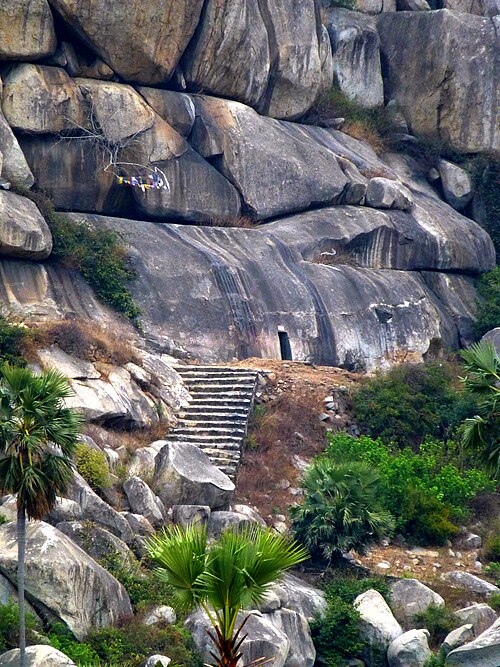
Dimensional analysis of the Mauryan rock-cut caves at Barabar and Nagarjuni yields a base unit of 1.763 cm – measured off cut granite, planned using the Arthashastra’s danda. The same base unit shows up at Harappan sites, suggesting a metrological tradition carried forward largely unchanged.
This is not a textual inference. It is a real physical measurement of something you can go and stand inside and check for yourself! And they give us 1 angula = 1.763 cm
From grain
We already have barley to angula relation that we saw earlier, and barley can be measured as well! BUT, modern cultivars are the wrong reference – they have been selectivley bred for plumpness – so the right source would be a carbonized grain from Indian excavation sites.
At Kanmer, a Harappan site in Kachchh, Gujarat, the excavators report charred Hordeum vulgare (Barley) with mean length 4.95 mm and ratios L/B = 1.70, L/T = 2.68, B/T = 1.57. Solving for thickness two independent ways gives 1.847 mm and 1.855 mm.
Charred thickness = 1.85 mm. Modern barley is 2.5–3.0 mm indicating that the ancient grain really was much smaller. So yes, selective breeding has increased its size.
Now, carbonized cereals shrink as time goes by, typically to 10-25% in linear dimensions. So if we correct 1.85 mm by 16%, squarely in that range, we see that the living grain was 2.20 mm thick.
Now multiply by eight, as the tradition says:
8 × 2.204 mm = 1.763 cmThe same number the Mauryan stonemasons used.
Carbonised barley from a Harappan settlement in Gujarat, and chisel marks in Mauryan granite a thousand kilometres and a millennium away, give the same angula measurement!
That is the best finding in this entire investigation, and it reflects extremely well on the tradition. The yava-to-angula relation was not a schematic fiction. Eight grains of the barley they actually grew really did make the finger-breadth they actually built with!
The yojana, stands recovered
768,000 × 1.763 cm = 13.54 kmThe calculation — and the answer
2,202 × 13.54 km  = 29,815 km in half a nimesha
29,815 ÷ 0.10667  = 279,513 km per second
The true value of speed of light is 299,792 km/s. Off by 6.8%! And considering the fact that we might still have some error in our angula to SI unitr conversion, this is an amazing achievement in itself of ancient Indians.
For a calculation done atleast more than a thousand years ago! That in itself is startling enough!
Below is every angula measurement found in this investigation and what it yields
| Anchor | Angula | Speed | Error |
|---|---|---|---|
| Barabar caves, measured stone | 1.763 cm | 279,513 km/s | −6.8% |
| Harappan barley, charring-corrected | 1.763 cm | 279,513 km/s | −6.8% |
| Body height, 152 cm ÷ 84 | 1.810 cm | 286,889 km/s | −4.3% |
| Hand span, 22 cm ÷ 12 | 1.833 cm | 290,664 km/s | −3.0% |
| ¾ of an English inch | 1.905 cm | 302,026 km/s | +0.7% |
| Body height, 165 cm ÷ 84 | 1.964 cm | 311,426 km/s | +3.9% |
| Modern barley × 8 | 2.320 cm | 367,822 km/s | +22.7% |
Every anchor derived from something physical – stone, grain, bone – clusters between 1.76 and 1.96 cm, giving 279,000 to 311,000 km/s.
The one that produces the famous agreement is ¾ of an English inch.
The 1.89 problem
Now look closely at the figure the forwards actually quote: 1.89 cm, given to three significant figures, usually with “or approximately ¾ inch” beside it.
But ¾ inch is 1.905 cm, not 1.89.
I asked the calculator what angula would hit the speed of light exactly.
1.8909 cm – which is the quoted figure 1.89 cm!
The quoted figure sits within 0.05% of the value that makes the answer perfect. Shift it by 0.8% — less than the width of a pencil line — and the result moves by 2,400 km/s.
I am not alleging fraud; 1.89 may well be somebody’s honest estimate. But the angula is the only free parameter in the entire chain, and every version of this story forwarded reaches for the one value that lands it bang on the target. That is not a claim being tested. It is a claim being tuned, and the tuning happens in a single unstated word-choice six conversions before anyone touches a calculator.
If we are permitted to adjust the yojana until the answer matches, we are no longer testing the claim – we are fitting it. You can hit any target like that. That is not proof. That is doing arithmetic backwards and saying Yay!
Kak’s own conclusion is:
“It is a lucky chance that the final number turned out to be exactly equal to the true speed. Sayana’s value as speed of light must be considered the most astonishing ‘blind hit’ in the history of science!”
This is worth noting, as his paper is the one usually cited as proof of the claim. Always read the people you cite, and cite whom you read.
What is still open
Four questions I could not settle. Any one would be a real find:
- What text is Sayana quoting? Tathā ca smaryate points at a specific smriti source. Bhatta Bhaskara calls it an old Puranic tradition. Nobody has identified it. Locate that text and you have genuinely new information rather than a correction.
- When exactly did Bhatta Bhaskara live? Usually 10th century, with a question mark.
- Did Madhava comment on it? Sayana’s brother was a astronomer. He would surely have caught the problem if 2,202 was meant to be Sun’s orbital speed (which obviously cannot be as it would be self-contradicting calculations). But still, would be good to know if Madhava had any say on this.
What should we be proud of?
There is a great deal – even greater achievements. Just not the thing that people keep claiming.
Start with what this investigation actually uncovered. We recovered a 2,300-year-old unit of length from two independent physical sources, and they agreed. Carbonised barley from Gujarat and cut granite in Bihar both give an angula of 1.763 cm. The ratio the texts record – 8 barley grains to a finger-breadth – turns out to be a true statement about real barley and real fingers. The chain from grain to finger to span to cubit to bow-length to yojana is internally consistent, anthropometrically sound, and archaeologically confirmed.
That is a functioning metrological system, maintained across a millennium and a subcontinent. It deserves to be better known than the coincidence people keep forwarding instead.
To find the actual Speed of Light in modern times – Roemer needed Jupiter’s moons, a telescope and years of eclipse timings – and still came out roughly a quarter low. Fizeau needed a toothed wheel and eight kilometres of Paris! We have no idea how our ancients could have come so close to the actual value, and what methodology they might have used to make these calculations. After all, when the entire world was thinking that the Earth was flat, we have Varaha Avatar carrying Earth in the form of a globe – and that was in thousands of years old Dashavatara!
Then consider what had to be true for that one sentence (2200 yojagas in half a nimesha) to exist at all:
- Somebody had decided that light moves – and most importantly that it has a finite speed. In Europe, right up to Roemer in 1676, light was taken to travel instantly, and Descartes insisted on it. Here is an Indian tradition, a thousand years old, calmly trying to measure the speed of light!
- Somebody had a time unit fine enough to be useful – a fifth of a second, named after a blink, sitting in a clean chain.
- Somebody had a quantitative cosmology – a universe with an actual size in actual units, large enough that its size and the speed of light had to be related.
- And somebody asked: how fast must light travel, for the universe to be lit?
That last one is a physicist’s question. It is the same way a modern cosmologist saying that the observable universe is bounded by how far light has had time to travel. Aryabhata’s commentator Bhaskara I put it plainly in the 7th century – the sky itself is limitless, but what we may call the universe is only as much of it as the Sun’s rays illumine.
And notice what Yaska hands us. In a tradition that names the sun from roots meaning to move and to impel, and where the Rigveda calls Surya jyotir uttamam, the question “how fast does Surya travel” simply is the question “how fast does light travel.” They were not asking a devotional question that got lucky. They were asking the physicist’s question, using their vocabulary.
That is a real idea. It stands on its own. It does not need a coincidence propping it up.
Summary
- Rigveda 1.50.4 contains no number. It calls Surya swift, visible to all, and the maker of light.
- The figure of 2,202 yojanas per half nimesha comes from Sayana’s 14th century commentary, and Sayana says he is quoting an older tradition. The same line appears in a 10th century commentary by Bhatta Bhaskara.
- The line is genuine, not a forgery.
- “Sun or light?” is the wrong question. Yaska derives sūrya from roots meaning to move; RV 1.50.10 places sūryam and jyotir uttamam in apposition. The tradition does not split the luminary from its light.
- The nimesha is solid — 16/75 of a second, and it matches a real blink.
- The Vishnu Purana does not define the yojana. The chain comes via Wilson’s footnote citing the Markandeya Purana.
- The chain gives ratios, not lengths. Everything turns on the angula, and the tradition calls it swa-angula – your own finger, explicitly not universal.
- But a standardised angula can be recovered: 1.763 cm, from Mauryan cut stone and from charring-corrected Harappan barley, independently agreeing.
- At that yojana of 13.54 km, Sayana’s figure gives 279,513 km/s — 6.8% off, than the actual speed of light, but still an amazing achievement given its time.
- The famous 0.3% agreement requires an angula of 1.905 cm, which is ¾ of an English inch and sits above every physically anchored value.
Our ancestors did not just try to measure the speed of light. What they did was stranger, and to my mind even better – they built a universe out of numbers, and then asked how fast light would have to run to fill it!
That the answer comes anywhere near the truth may or may not be luck. BUT, that they asked the question at all, three centuries before Roemer, is not. And that we can still recover their ruler from burnt grain and cut rock, and find it consistent to within a hair – that is not luck either. That is what a civilization leaves behind when it takes its measurements and mathematics seriously.
References
- Kak, Subhash. The Speed of Light and Purāṇic Cosmology. arXiv:physics/9804020 (1998); also Indian Journal of History of Science, vol. 33 (1998), pp. 31–36.
- Müller, Max (ed.). Rig-Veda-Samhita together with the Commentary of Sayana. Oxford, 1890.
- Wilson, H.H. (tr.). Rig-Veda Sanhita, with Sayana’s bhashya.
- Wilson, H.H. (tr.). The Vishnu Purana, 1865 — Book 1 ch. 6, footnote, citing the Markandeya Purana for the chain of land measures.
- Yaska, Nirukta 12.14 (derivations of sūrya); 7.5; 12.16.
- Malviya S. et al. Comparative Evaluation of Anguli Pramana in the Brihattrayi. International Journal of AYUSH, vol. 15 no. 7 (2026) — for Swa-Angula and the 84-angula body height.
- Markandeya Purana – Chapter 49
- Balasubramaniam, R. New Insights on Metrology during the Mauryan Period — Barabar and Nagarjuni caves, angula = 1.763 cm.
- Pokharia, A.K. et al. Archaeobotany and archaeology at Kanmer, a Harappan site in Kachchh, Gujarat — charred Hordeum vulgare measurements.
- Shrava, S. History of Vedic Literature, 1977, p. 185 — the 1395 Vadodara manuscript.
- Shukla, K.S. Aryabhatiya of Aryabhata with the Commentary of Bhaskara I and Someswara, INSA, 1976, pp. 26–27.
- Rømer’s determination of the speed of light — Paris Académie des Sciences, September 1676.
- Speed of light in vacuum, exact by definition: 299,792,458 m/s (SI, since 1983).
Note on method: all arithmetic in this article was computed directly in SI from the source figures, not converted from earlier published results. Where a range of values is attested, the range is given rather than the most flattering member of it.
EDIT: Updated on 27 Aug 2026 based on new facts and insights revealed by a detailed research done by the author