Let us start this Sanskrit Learning Series by asking a few questions.
- What makes Sanskrit so different from most other human languages?
- Why is Sanskrit grammar described as being so structured and precise?
- What makes it the Deva Bhasha, the language of the Gods?
- Why does the same Sanskrit sentence sometimes carry multiple meanings?
- Why do Sanskrit words rarely need to be borrowed from other languages, when other languages borrow from everywhere?
- And why did a language that was fixed by grammarians thousands of years ago never needed to change afterwards?
Preface to learn Sanskrit
In this series lets first try to understand what makes Sanskrit stand apart among the thousands of languages humans have spoken. Its not just its structure or precision, but most importantly its enormous capacity to carry knowledge inside the words themselves! As a preface, you may want to read Why Sanskrit was considered an important language in ancient India?
Please note, this is not a conventional Learn Sanskrit course. The approach here is more like watching a suspense thriller than sitting through a documentary. If you are looking for Learn Sanskrit in 5 Days, I am afraid this is not for you. My effort here is to make you appreciate the beauty of this language – and while appreciating it, to learn it, slowly but surely – with passion and confidence.
One more thing before we begin. I have no interest in making claims about Sanskrit that cannot survive a serious inquiry into the fact. The language does not need exaggeration. What is actually true about Sanskrit is remarkable enough (as you shall see), and a claim that collapses under scrutiny does more damage to Sanskrit than a hundred critics ever could. So wherever the popular story and the evidence disagree, we shall follow the evidence – and you will find, more often than not, that the evidence is more interesting anyway :)
Let us start.
Why do Hindu Gods have lots of names?
We all have one official name – the name in government documents. Maybe a couple of pet names, nicknames, a pen name etc. Four or five, at the most.
Now how about 108 names? Or a thousand?
In Hinduism, deities have far too many names. Ashtottara lists of 108 names, Sahasranamavali of a thousand! How on earth can one person be known by a thousand different names?
The answer is that these are not names at all in the way we normally use the word. Each one describes an attribute, ie a property about whom/what it describes. Take Ganesha for instance:
- Ekadanta – the one with a single tusk
- Gajavadana – the one with an elephant’s face
- Mushika Vahana – the one whose vehicle is a mouse
- Vakratunda – the one with a curved trunk
- Vighneshvara – the God of obstacles
- Ganesha – the head of the Ganas (the semi-divine attendants of God Shiva)
Vighneshvara here doesn’t mean “remover of obstacles”, as it is usually translated. It means god of obstacles – the one who both places them and removes them. So God Ganesha might sometimes create obstacles in your path for your own good! He is both Vighna Kaaraka and Vighna Nivaaraka at the same time! That double role is the whole point, and the popular translation quietly loses half of it. This will happen repeatedly in this series.
So if each one of these is an attribute, then what is the real name of Ganesha?
One thing, many names – the core feature of Sanskrit
It is not just limited to our Gods. It is the feature of Sanskrit language itself! Below is the same pattern again, but now with ordinary things.
Lotus is popularly Kamala in Sanskrit. But it is also called Jalaja, Varija, Ambuja, Neeraja, Pankaja and many more.
Sea is usually called Samudra. But it also has Jaladhi, Varidhi, Ambudhi, Neeradhi etc as its other names.
Have a close look at those two lists of names again. They look almost identical, except for their endings. Lotus ends in ja, sea ends in dhi. So what are these common prefixes?
Jala, vari, ambu, neera all refer to water!
Ja means born of. Add ja to anything that means water, and you have named something born in water. Lotus is born in water – so it collects every one of those names at once.
Dhi means abundance. Water is abundant in sea. So take any word for water, add dhi, and there that can mean sea!
Did you notice that Pankaja means lotus, but no Pankadhi for sea? That is because panka is mud, not water. Lotus is born in mud, so it earns Pankaja as well. And Pankadhi? Well, if you know something in which mud is abundant (like water in sea), you may call it Pankadhi.
Hold on! You have just created a Sanskrit word! – Pankadhi
And Kamala?
kam alaṅkaroti iti kamalam
कम् अलङ्करोति इति कमलम्
The one which adorns the water is Kamala!
Ka is another Sanskrit word describing water – add it to our earlier jala, vari, ambu and neera. Alaṅkaroti means adorns (from alaṁ and the root word kṛ). So Kamala is the ornament of the water. Another water word, another relation!
There is a second derivation too – kam lāti iti kamalam, “that which draws from the water,” using the root word lā (to take).
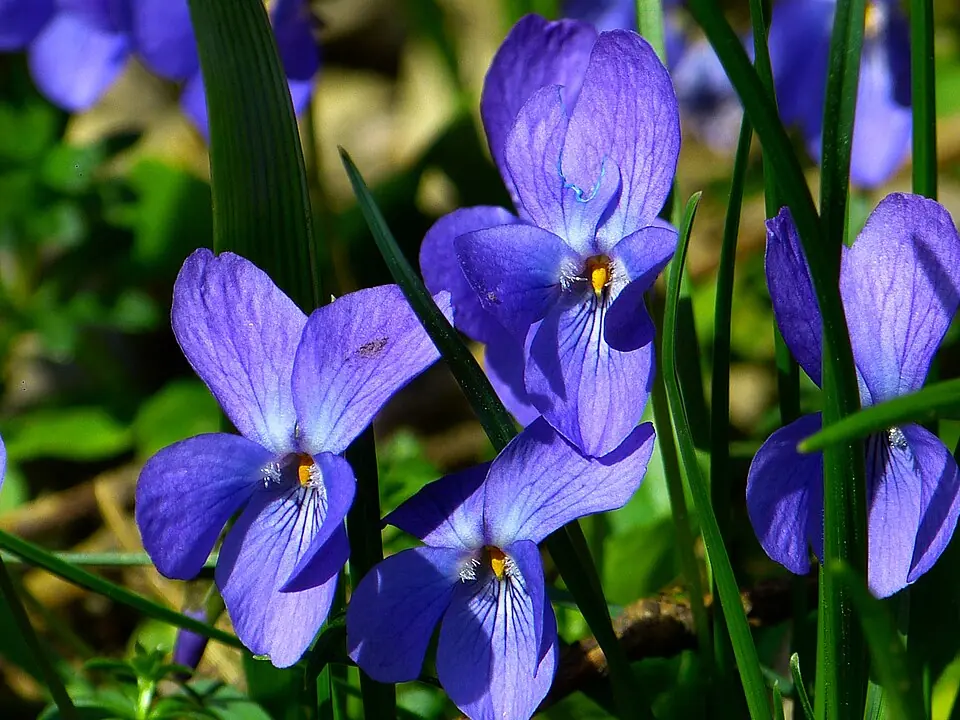
kamala is also recorded as an adjective which means pale-red or rose-colored, and in that way it is talking about the color of lotus. However note that the color sense appears only in the lexicographers and not in actual literature, which hence refers to a back-formation. That is, the color was almost certainly named after the flower, not the flower after the color – similar to how rose and violet are colors in English because of the flowers, not the opposite.
Samudra is sam (a gathering) + udra (water) => a gathering of waters. A sea is a gathering of river waters, an ocean is also a gathering of sea waters — hence, both are Samudra.
Similarly, sad means the act of sitting. So Samsad is a sitting-together. Which is exactly what our Parliament is :)
Bonus: what is Kamalaja? Kamala is lotus, ja is born of. Who is born of the lotus? Brahma! Which is why he is also called Kamalaja. And Kamalanabha is Vishnu, because nabha is navel and the lotus sprouts from his navel. Which means Ambujanabha and Varijanabha are also Vishnu. We hear these names of Vishnu in a lot of Dasara Padas in Kannada. Of course, all Indian languages are heavily influenced by Sanskrit – which is quite natural.
And now, a complication.
Where the rule bends – Yaugika and Rudhi
If Pankaja means “born of mud”, then frogs are Pankaja too! So are worms, reeds and half the things in a paddy field :)
But nobody uses Pankaja for a frog. In every day use, it always means lotus.
Ancient Sanskrit grammarians knew this as well, and they built exceptions into the system. They classified words three ways:
- Yaugika – words that are clearly derived from their parts.
- Rudha – words that by by convention mean just one thing, like our usual names, and the parts no longer decide its meaning, it has been fixed to one entity in general everyday usage by practice (Rudhi).
- Yogarudha – the parts still make sense, but convention has narrowed the word to one entity.
Pankaja is a classic textbook example of yogarudha. The derivation is clearly visible, and yet common everyday usage has fixed it to lotus.
And there is another category which we should be aware of – yadrccha, meaning arbitrary. Words applied with no attribute basis at all! Ancient Nyaya texts have two examples on hand for it, Dittha and Davittha, because they mean nothing – they are fictitious name – like xyz, abc, blah blah blah. Like the dummy text Lorem Ipsum – the moment we see it in a web page, we realize the page has no useful information (The words come from an old Latin book, but they are scrambled to make no sense).
The great grammarian Yaska, in his Nirukta, records a debate on this. Yaska says that nouns can be traced back to verbal roots. But another scholar, Gargya, objects – if that were true, he says, everyone who travels would be called a horse! The debate is thousands of years old, and our tradition preserved both sides of it. After all, the Indian way of knowledge has always been about having lengthy debates – allow counter view points to peacefully co-exist. The end game is to find the truth (satya) – not “my way is the highway” attitude.
So the truth is:
Sanskrit is not a language without arbitrary names. It is a language in which arbitrariness is the rare exception rather than the ordinary rule.
Now Compare. In English, lion is a dead sound, on its own it tells you nothing. Its history is buried in Latin and Greek and is invisible to any English speaker. Now take Sanskrit. Simha which means the powerful one, Kesari means the maned one, Gajari means the enemy (ari) of elephants (Gaja). Three names, three facts, yes, names are facts (aka knowledge)!
That is the real difference. Not that Sanskrit bans arbitrary names, but it almost never needs them – and more importantly, Sanskrit words carry their knowledge on their face instead of hiding it inside a dictionary.
So, while languages like English mostly have only Rudha names, almost all Sanskrit names are Yaugika (next being Yogarudha, and only very few rudha names)! So do most Indian languages, as they are heavily influenced by Sanskrit.
What this means that if you know ten Sanskrit names of a fruit, you know ten facts about that fruit! Usually two to three names (that denote two or three unique facts) are more than enough to uniquely identify any entity! The magic then is, with very limited attribute names, you can name anything and everything in this universe! No need to create a million names for a million entities, and a completely new one for the next.
This is the very same principle on which ancient Indians invented mathematics as we know today, ie the place value system where a place value based system with a fixed set of digits can represent any number no matter how big! Contrast this with Roman numerals where you repeatedly end up using new letters and markings for larger numbers – the L, C, D, M and so on!
Even elephants explain themselves
Consider Hasti, which we know is an elephant. Hasta is hand though! Hasti is the one with a hand — because a trunk does the work of a hand. You will never derive any such fact about Elephant from the English word elephant. You cannot miss it in Hasti.
Dvija means twice-born (Dvi is twice, ja as we saw earlier born). It may refer to a bird, because a bird is born once as an egg and again out of it. It can also refer to a tooth, for the same reason – milk teeth, then permanent. And it also refers to a learned person, because to be educated is to be born a second time into a world you now see completely differently. That is why the learned ones (Brahmin means a learned one) are also called Dvijas.
One word. Three pointers. And all three make immediate sense the moment you know what the word is made of.
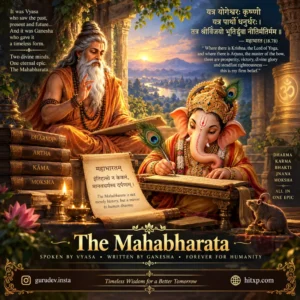
Why was Veda Vyasa also called Krishna Dvaipayana?
Krishna means a dark complexion. But then why was Veda Vyasa, the compiler of the Mahabharata, also called Krishna Dvaipayana? This confused me when I was young while reading the Mahabharata.
Dvipa means island, and Dvaipayana is the one born on an island. Veda Vyasa was dark-complexioned and was born on an island. By practice (Rudhi), Krishna refers to God Krishna in Mahabharata, so Krishna Dvaipayana (just add another attribute), and we know it is Veda Vyasa, because we know Krishna was not born on an island, so it must be Veda Vyasa!
NOTE: The core Sanskrit principle is, give basic meanings to root words, combine and reuse them to mean anything! And, that combining is called Sandhi and Samasa – the rules about how to merge root words into a single compound word. Remember this, the core atomic root words are called dhatus in Sanskrit, they never appear as separate entities in Sanskrit sentences, but all words (pada) are built on top of them!
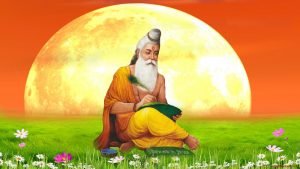
Veda Vyasa collected, divided and arranged the Vedas and made them available in the form we have today (the four vedas), and earned the title Veda Vyasa — the divider, the arranger of the vedas. Veda – the entire knowledge known to humanity at that point of time.
Yes! Vyasa is a title, not a name. Our own Puranas say it – listing 28 Vyasas, one appearing in each Dvapara Yuga to arrange the Vedas for that age. Krishna Dvaipayana is the twenty-eighth of them. As knowledge increases, so does the volume of the vedas, and what we have now is the 28th version of it!
Do you see what this means? Even “Veda Vyasa” is an attribute. It describes a task, and it belongs to whoever completes that task!
People earn more names through their deeds
Children were named for their attributes visible at birth. A girl born on a full moon is Poornima. Ashtavakra was called so because he was born with eight deformities in his body — ashta, eight, and vakra, curved (deformity). Yes, the same vakra as in Vakratunda.
And then, depending on what they did or achieved throughout their lives, people collected more names – like Veda Vyasa. Names for what they achieved, whom they defeated, what they built, what they gave away. A biography compressed into a list of words – with a few words you can describe that person, ie summarize! For instance, Daana Shoora Karna! Satya Harishchandra!
This is why the Sahasranama exists. A thousand names is a thousand facts. When you chant it, you are not chanting thousand names. You are reciting thousand descriptions! Which is also why some of those names repeat across different Gods! For instance, Vishnu Sahasranama has both Shiva and Eshwara as names of Vishnu! And, Vishnu is a name of Shiva in the 1000 names of Shiva in Shiva Purana!
Sanskrit is a Context based Language
Now, Attribute names come with a cost though.
Ambara can mean cloth, or sky. When we say Shwetambara, shweta being white, we mean white cloth. Shuklambaradharam means the one wearing white cloth. But when ambara carries the sense of the limitless, it means sky.
Ambara can also be cotton, saffron and a kind of perfume. One word, several senses, chosen by context alone. So context becomes important. As we saw earlier in Krishna Dvaipayana, neighboring words refine the context.
“I want to buy an Apple” can mean either the fruit or an iPhone!
So imagine a translator doing word to word translation ignoring the context, takes ambara as sky when the verse actually meant cloth. “The sun in the sky” becomes “the sun is wearing the dress”. And then some clever(?) person quotes the mistranslation as proof that the text is childish nonsense.
Sanskrit cannot be translated word by word. The context decides the meaning, and there are rules and signals for reading that context which we will learn in future lessons.
One good example. The word go or gau commonly means cow. But it also means a ray of light, the earth, speech, the sense organs, water, etc. So when a verse uses go, the translator has to choose carefully based on the context, looking at adjacent words — and the wrong choice can change the meaning of a sentence completely!
Now, let me be careful here, because this point gets pushed much too far.
We often read or hear about debates about claims that rest entirely on this one or two mistranslated words. About translations that makes the test look absurd, the mistranslation becomes so obvious because one starts wondering, who on earth will write such meaningless stuff using such an amazing language!
A translator who does not know that go has a dozen meanings will not even know a choice is being made! That is a real problem in translation. It does not need to be always inflated into a conspiracy to be worth pointing out. It just exposes the ignorance of the translator.
Embedding whole stories inside a sentence
Here is where the fun begins.
Because meanings depend on context, a skilled poet can write a sentence in which two valid contexts are true at once. This is called shlesha, and Sanskrit literature took it to places no other literature has been to!
Look at Raghavapandaviya by Kaviraja, from around the 12th century. It narrates the Ramayana. But it also narrates the Mahabharata! Not in alternate chapters — in the same verses, simultaneously, at the same time! Every line has to work as Rama’s story and as the Pandavas story at the same time, throughout the poem, till the very last word!
Next, read the Ramakrishnavilomakavya by Surya Pandita. If you read it forward as usual, it tells the story of Rama. Read the same syllables backward and you have the story of Krishna!
Just sit with that for a moment and digest the fact. These are not party tricks!! They are only and only possible in Sanskrit, and that is because Sanskrit words point at attributes rather than at fixed objects, so a single word can legitimately land on two different referents that share that attribute! It is shared mathematical space in action! Set intersections and unions at play! Words become classes of algebraic structures!
This is also why the mahavakyas of the Upanishads can be so short and so deep. Tat tvam asi. Aham brahmasmi. Ayam atma brahma. Three or four words each, and commentators have been writing books on them for thousands of years without exhausting them. The sutras across Sanskrit texts are very tiny compressions of lengthy facts! Panini’s Ashtadhyayi itself is an amazing example. The entire Sanskrit grammar compressed into nearly 4000 sutras!
The Mahabharata itself refers to a set of verses whose full meaning was known only to Vyasa, his son Shuka, and partly to Sanjaya. Whether one reads that literally or as the epic’s own way of telling us that its verses run deeper than they appear, the point stands: this language was built to carry more than one thing at a time. That is data compression at play by the data itself! no external compression algorithms needed!
Does Sanskrit have loan words?
You will often read that Sanskrit has none. That claim is too strong, and it is easily disproved — so let us get it right, because the accurate version is still impressive.
Sanskrit does have loan words. There is a body of vocabulary that most linguists trace to Dravidian and Munda sources — mina for fish, langala for plough, kadali for banana.
neera, one of our four words for water we saw earlier, is itself a strong candidate for a Dravidian borrowing, from the Tamil neer.
Does this diminish Sanskrit? Not in the least possible way. Look at what really happened. Sanskrit took a loan word and put it to work under its own rules. Neera became Neeraja and Neeradhi. Whatever came in from outside was immediately handed over to the root-and-suffix machinery and made to follow its rules!
Sanskrit borrows less than almost any language because there is no real need for it. New words can ALWAYS be created using its core machinery – the dhatus, the inflections, the sandhi samaasa rules. English and other languages borrow because they have no well defined way to make new words. Sanskrit has a complete machinery at its disposal which we shall low slowly but steadily. The crux is, when something new appears, you look at its attributes and you build a new word following the rules of the language. Read the list of mainstream core English words derived from Sanskrit.
Building a word for “download”
Edit: Since many readers asked about giving a practical example of creating new words in Sanskrit by creating a new word for Download, have updated the article with words for download and upload.
Let us give it a try.
The act of descending or coming down is avarohana, which comes from ava, downward, and the root ruh, to climb or mount. So avarohayati – causes something to come down. Now that is our download!
Going up is arohana. So arohayati – causes something to go up. Upload.
Notice the pair holds together. Same root, opposite prefixes, exactly mirroring what upload and download actually are..
And yes, its the same arohana-avarohana we come across in singing – ascending and descending notes that is. Parvataarohana is climbing the mountain (Parvata) – words are always reused
EDIT: Earlier I had suggested unnati and avanati for the same. Please do not use them. Unnati means progress and avanati is decline, so “file avanati” reads as file degraded or corrupted, not file downloaded. Thanks to the reader who highlighted this in the comments years ago. The prefixes work, but the sufffixes do not.
This is the discipline the language demands. You cannot simply glue syllables together and declare it Sanskrit. The parts have to actually mean what you need them to mean. That constraint is exactly why the words end up being meaningful.
Now try it for yourself. What shall we call a search engine? Something that seeks, anveshana. A screen? A thing that shows, or a thing that is a surface for light. There is no one right answer, and thats the point. The options are genuinely endless.
Now hope you also understand why Hindu Gods have chants with 108 names, 1000 names etc?
Take the case of the names of God Shiva. Shiva, Manjunatha, Jagannatha, Vishwanatha, Eeshwara, Ardhanaareeshwara, Mrityunjaya, Mrda, Gangadhara, Shoolapaani, Pashupati, Nagabharana, Nandivaahana, ChandraShekara, and lots more all refer to the various attributes of Shiva.
Refined – that is Sanskrit
Vedic Sanskrit is the original and the oldest form of Sanskrit. The sanskrit we use today (since Panini’s era) is the Classical Sanskrit standardized by Panini. Vedic Sanskrit has a pitch accent – udatta (high pitched tone), anudatta (normal low pitched tone), svarita (like singing from high to low – that bridges udatta and anudatta) – which Classical Sanskrit lost.
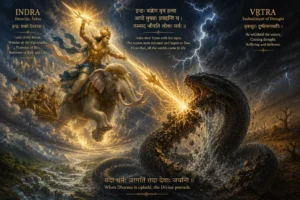
Do you know what this means? It means in Vedic Sanskrit, even the pitch used to pronounce can change its meaning! The same word pronounced merely in a different pitch can mean entirely the opposite! Read the interesting story of Vritrasura to see how even pitch mattered in the original Sanskrit!
Vedic Sanskrit also has the subjunctive mood and a wider range of infinitive forms which Classical Sanskrit dropped. In all, Classical Sanskrit is a simplified form of Vedic Sanskrit.
Panini himself records that Sanskrit had changed before his time. All through the Ashtadhyayi he specifies certain forms as chandasi, ie “in the Vedic”, and others bhashayam, meaning “in the spoken language”. He is informing us, rule by rule, that the older Vedic usage and the current usage were not the same (in his time already!).
Panini also names ten grammarians who came before him – Apishali, Kashyapa, Gargya, Galava, Chakravarmana, Bharadvaja, Shakatayana, Shakalya, Senaka and Sphotayana. So obviously a lot of work had already happened on Sanskrit grammar and rules much before Panini himself! Panini kind of finalized things for Sanskrit.
So how did Sanskrit come into being then? Look at the name of the language itself. Samskrita means thoroughly made, refined, perfected by work. Not “invented”. Refined. And it stands in deliberate contrast to Prakrita, the natural or unrefined speech.
The existing Prakrit forms of the time were refined into a standardized form – Sanskrit, so that while it remained familiar to Prakrits, it was at the same time bound by its own rules – probably the world’s first grammar – making it a standard for knowledge representation and hence education. The attribute based rules allowing creative combinations inspiring an explosive amount of literary works from Vedas to everything ever since! It became the medium of education in ancient India, just like today English is. Knowledge of Sanskrit became synonymous with being educated. The world’s oldest center of higher education, Takshashila where students from all across the world came to study – taught in Sanskrit.
Here is what Panini did, and it is one of the great intellectual achievements of the human species. He took a living language and wrote close to four thousand rules that describe it with such completeness and such economy that the language stopped drifting after that. Sanskrit did not stop evolving because it was frozen at birth. It stopped evolving because somebody described it so well that there was nothing left to standardize! It now had everything that a human spoken language would ever need!
Every other major language of the world has drifted so far that its speakers cannot read their own literature of a thousand years ago without training. Try making an English speaker read Chaucer’s The Canterbury Tales. They cannot! But a student who has learnt Panini’s Sanskrit can read Kalidasa and can also read the Upanishads, and any Sanskrit works of today with same ease!
That is the real marvel. Not a language that fell from the sky, but a language that ancient Indians made so perfect, that its structure became permanent.
I find that to be far more worth celebrating. Isnt it?
And what about computers?
You might have heard that Sanskrit is the language best suited for computers, for AI and sometimes that some space agency is going to program in it. Let us separate fact from fiction.
The claim traces to a 1985 paper by Rick Briggs in AI Magazine, called “Knowledge Representation in Sanskrit and Artificial Intelligence“. What Briggs actually argued is narrower and more interesting than the version that actually circulates in emails, social media and WhatsApp groups. He pointed out that the highly regimented technical prose our grammarians developed – the shastric style, built for stating rules unambiguously – closely resembles the semantic network notations that AI researchers had independently arrived at. He was not claiming that ordinary poetic Sanskrit is unambiguous. Obviously it is not; we spent half this article celebrating exactly how ambiguous it can be, and hence misinterpreted and incorrectly translated by those whose knowledge about the subject is incomplete.
And no space agency ever adopted Sanskrit. That part was invented somewhere along the way.
But there is a genuine connection, and it is a good one. Panini’s method – a finite set of rules, ordered, with later rules overriding earlier ones, using a metalanguage to describe an object language – is structurally what a modern grammar specification does. It is exactly how all the compilers of different computer programming languages like C, Java, Rust, Go are all written, which actually forms the core of computers and computing!
In 1967, the computer scientist Peter Ingerman wrote to the Communications of the ACM proposing that Backus-Naur Form be renamed Panini-Backus Form as an acknowledgement of Panini being the first to be there. Yes, by encoding an entire language as a set of rules in Ashtadhyayi, he had detailed down the rules that could be used by a Sanskrit compiler, thousands of years before the first computers were invented! No such algorithm exists even today for any other language across the world. And Panini wrote it for Sanskrit more than 2,500 years ago!
Backus did not read Panini. That is the striking part. Two minds, two and a half millennia apart, working on how to describe a language precisely, arrived at the same shape of solution. Panini got there first, by a very long way.
That deserves to be stated accurately, because when stated accurately, it is genuinely astonishing. Dressed up with a fake space program, it becomes a story people stop believing in.
Summary of Sanskrit Lesson 1
- In Sanskrit, names overwhelmingly point at attributes and properties, not at fixed objects.
- The same object therefore collects many names, each recording a different fact about it.
- Because attributes are shared, the same word can point at different objects in different contexts. Meaning is context-sensitive, and word by word translation destroys it.
- Convention does harden some words onto single referents – this is rudhi and yogarudha – and the tradition acknowledged arbitrary names too. The rule is overwhelming, not absolute.
- Because words are built from roots, Sanskrit can coin new words at will and forever infinitely and doesn’t needs to borrow.
- Shared attributes let a poet mean two things at once. This is shlesha, and it produced poems that tell two epics simultaneously!
- Sanskrit was refined and then fixed by Panini so completely that it stopped changing. That is what Samskrita means.
- We have just touched the tip of the iceberg. More lessons to follow. So stay tuned :)
Sanskrit does not need us to exaggerate on its behalf. It has survived thousands of years of use. We have had grammarians who understood it better than anyone has understood any language since. We saw poets who could write two epics in one breath.
A language like that can afford the truth.
Ekam sat, viprah bahudha vadanti
'Truth is One, the wise call it by many names'
And now you know why that verse says many names. It could not have said anything else.
Vasudhaiva Kutumbakam
'The whole earth is one family'
Sarve janaha sukhino bhavantu
'May all beings live happily'
Om Shanti Shanti Shanti
'Let there be peace everywhere'
Continue to Sanskrit Lesson 2 – Dhatus, the magic roots of Sanskrit
As always, if you find an error in this article, please point it out in the comments. Several corrections in this version came from readers, and the article is better for every one of them.
EDITED: on Aug 24, 2026 (updated based on research into earlier comments and new facts realized by the author)