Remember this vedic chant sung in the schools?
Om Saha Navavatu, Saha Nau Bhunaktu, Saha Viryam Karavavahai,
Tejasvi Navadhitamastu Ma Vidvishavahai
Om Shanti Shanti Shanti hi
It comes from the Yajurveda. To be more precise, from the Taittiriya Upanishad of the Krishna Yajur Veda. It is a prayer where both, the Teacher and the Student, stand on equal footing, acknowledging that the transmission of knowledge requires absolute harmony between the person sharing it and the person receiving it.
The Sri Rudram, the Taittiriya Upanishad and the Narayana Sukta all come from Yajurveda. They are recited with the full Vedic pitch accents, and the famous memory patterns called jata and ghana are practised on Yajurveda texts just as they are on the Rigveda.
So the Yajurveda clearly has a chanting tradition. What it does not have is melody. Nobody stretches its words into song the way the Sāmaveda does. Why not?
The answer starts with a definition
Mimamsa, the old school of Vedic interpretation, sorts mantras into three kinds (Jaimini’s Sutras 2.1.35–37):
- Rik: a verse in metre.
- Saman: a mantra that is sung.
- Yajus: everything left over, which mostly means prose formulas.
The word yajus comes from the root yaj, “to sacrifice” or “to worship”. A yajus is a short working line, said while doing something: “I take you at the impulse of the god Savitṛ…” or “For Agni, svaha!” It is said during an action, such as pouring ghee, cutting grass, laying a brick or measuring the altar. It is basically, the action put into words.
One caution though. The Yajurveda as a collection is not just prose. It also has many verses: parts of the Rudram and all of the Narayana Sukta are composed in metre. The prose formula is the Yajurveda’s signature, not its entire content.
It belongs to the priest with his hands full

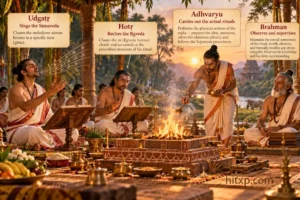
In a Vedic ritual, each Veda has its own priest:
- The hotr recites Riks. He invites and praises the gods.
- The udgatṛ sings Samans.
- The adhvaryu uses the Yajus. He does the physical work: measuring the ground, building the altar, tending the fire, cooking and pouring the offerings.
A fourth priest, the brahman, watches over the whole rite to ensure nothing is missed.
The adhvaryu’s work needs exact timing and full attention on the task. A long, flowing melody draws the mind inward, which suits the singer but not the man handling fire and bricks. The old texts do not put it in these words, but the reading fits the facts: his lines are short and plain because each one has to match a single gesture. In his mouth the word is not something to dwell on. It is the intention behind the act.
Why it is often whispered
The ritual tradition says that Riks and Sāmans are voiced aloud, while a yajus is said upamshu: in a low murmur voice, lips moving, but barely heard. The main exception is the nigada. It is said loudly because it is a yajus that gives an instruction to another priest.
The Bṛhadāraṇyaka Upanishad (1.5.5) offers a matching image:
vāg eva ṛgvedo, mano yajurvedaḥ, prāṇaḥ sāmavedaḥ
Speech is the Rigveda, mind is the Yajurveda, breath is the Sāmaveda.
The Upanishad is not explaining chanting rules here. It is pairing speech, mind and breath with several sets of three. Still, the pairing suits the pattern well. The Rik is spoken outward. The Sāman is breath, drawn out long. The Yajus is mind: intention aimed at action, so it turns inward and quiet.
Putting it together
Here is one way to read the three:
- The Rik names the thing.
- The Sāman lets you dwell in it.
- The Yajus turns your intention into a deed.
Action does not need the voice to grow into music. It needs the word held close to the hand. That is why the Yajurveda was never turned into song: singing would have worked against the very thing it was for.