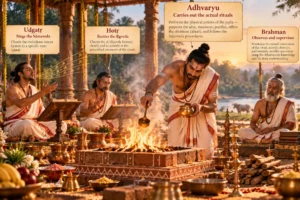
Among the 4 vedas, Sama Veda stands out with one difference – for one, it is sung, not chanted, but even more interesting is that almost all its verses are from the Rig Veda! Yet, tradition counts it as a separate veda. How then can it be a separate veda in itself?!
In Gita, Krishna says that among the vedas he is the Sama Veda!
vedānāṃ sāmavedo ‘smi
वेदानां सामवेदो ‘स्मि
ವೇದಾನಾಂ ಸಾಮವೇದೋ ‘ಸ್ಮಿBhagavad Gita, chapter 10, verse 22
It comes in the Gita’s chapter where he lists the best or most essential things in each category as a form of himself. it is the same verse where he says among the gods he is India, and he is the mind among the senses. A little later (10.35) says that among the Sāman songs he is the Brihat-sāman.
So what is so special about Sama veda then? The difference is not in the words. It is in what singing it does to the person who sings them.
The puzzle
It is said that the Rig Veda stands for sattā, pure existence, and the Sama Veda for jñāna, knowledge. That sounds odd if you look at the texts. The Sama Veda has 1,875 verses, out of which all but 75 come directly from Rig Veda (Samaveda overview). Samaveda is like “Rigveda tuned”
So the question is , if the words are same, how can singing turn “what is” into “what is known” ?
First, a caution about labels
No single, agreed list matches each Veda to one idea. Different schools use different lists.
One common modern list gives the Rig Veda to knowledge (jñāna), the Yajur Veda to action (karma) and the Sama Veda to worship and meditation (upāsanā). You can see it in the introduction to a Sama Veda translation in the Dayananda tradition. In that list, the Rig Veda gets “knowledge”, not the Sama Veda.
Still, the essence of what they mean about the two Vedas makes the idea easy to follow.
The true meaning of Knowledge
In Indian tradition, saying something exists is just information, sattā (existence), not knowledge (which is jnyāna). Jnyana is direct cognition, where the knower is absorbed into what is known. it is not a mere statement. In vedic yajnya, Hotr (the reciter of Rigveda) recites the Rk (Rigvedic verse) to invoke and establish the deity’s presence. The Udgātr sings the Sāman (Samavedic verse) so that the presence becomes something experienced! Some call the experience Jnyana and some call it upasana or dhyana.
But the idea remains the same – the difference between saying something, understanding something, experiencing the understanding. When we watch an interesting movie, we are immersed into it, become part of it and that is where the difference between knowing it’s story and experiencing it lies.
What the Upanishads say
Chandogya Upanishad
The Upanishads pair the Rik (a Rig Veda verse) and the Sāman (a Sama Veda song) side by side. The Chandogya Upanishad, which belongs to the Sama Veda, says:
vāg eva ṛk, prāṇaḥ sāma
वाग् एव ऋक्, प्राणः साम
ವಾಗ್ ಏವ ಋಕ್, ಪ್ರಾಣಃ ಸಾಮ
ṛcy adhyūḍham sāma
ऋच्य् अध्यूढम् साम
ಋಚ್ಯ್ ಅಧ್ಯೂಢಮ್ ಸಾಮ
The same passage plays with the word itself. Sā (“she”) is the earth and ama is fire, and together they make sāma.
ezAM BUtAnAM pfTivI rasaH pfTivyA apo rasaH । apAmozaDayo rasa ozaDInAM puruzo rasaH puruzasya vAgraso vAca fgrasa fcaH sAma rasaH sAmna udgITo rasaH ॥ १.१.२ ॥
एषां भूतानां पृथिवी रसः पृथिव्या अपो रसः । अपामोषधयो रस ओषधीनां पुरुषो रसः पुरुषस्य वाग्रसो वाच ऋग्रस ऋचः साम रसः साम्न उद्गीथो रसः ॥ १.१.२ ॥
ಏಷಾಂ ಭೂತಾನಾಂ ಪೃಥಿವೀ ರಸಃ ಪೃಥಿವ್ಯಾ ಅಪೋ ರಸಃ । ಅಪಾಮೋಷಧಯೋ ರಸ ಓಷಧೀನಾಂ ಪುರುಷೋ ರಸಃ ಪುರುಷಸ್ಯ ವಾಗ್ರಸೋ ವಾಚ ಋಗ್ರಸ ಋಚಃ ಸಾಮ ರಸಃ ಸಾಮ್ನ ಉದ್ಗೀಥೋ ರಸಃ ॥ १.१.२ ॥
- Earth is the essence of all living and non-living beings.
- Water is the essence of the earth.
- Plants/Vegetation are the essence of water.
- Human beings are the essence of plants.
- Speech is the essence of human beings.
- Ṛg Veda is the essence of speech.
- Sāma Veda is the essence of the Ṛg Veda.
- Udgītha (the syllable Om) is the essence of the Sāma Veda
Brihadaranyaka Upanishad
The Brihadaranyaka Upanishad repeats this word play with speech as sā and breath as ama (1.3.22). It adds a second one: breath is called Sāman because it is sama, “equal”. It is the same in a grub, a gnat, an elephant, the three worlds and the whole universe. It also plainly confirms that the Rig Veda is speech, the Yajur Veda is mind and the Sama Veda is breath (1.5.5).
These are word plays, however the picture is steady and consistent. The Rik is the thing said, the solid base. The Sāman is the breath that carries it and fills it. The Sāman needs the Rik, but it is not the Rik.
What singing does to a verse
The Sama Veda verse book holds only the words. The tunes live in separate song-books called gānas, and there the verse is reshaped for singing.
- Vowels are stretched over many beats.
- Words are broken apart and syllables are repeated.
- meaningless syllables called stobhas are added. Example: him, hO, hAi, huvA, ahA. The 13th Stobha syllable discussed extensively in ancient commentaries is Hum, which signifies deep spiritual resonance.
- The song is cut into phrases shaped by the singer’s breath.
A listener sometimes cannot follow the sentence while it is sung. Whether that was planned is open to debate. Some think that the tunes are older than the verses, and the words were bent to fit them. Either way the result is the same: attention moves away from the meaning and onto the sound and the breath.
Saying it and singing it
Think of two ways to meet that line, “O Agni, come to the feast”.
- You recite it. It is a clear sentence. It names a god and asks him to come. The words point at something, and your mind follows the meaning. This is the Rik doing its job: saying what is.
- You sing it the Sama way. You spend a whole breath on one or two syllables, then another breath on the next. You can no longer hold the sentence in your head. The mind settles on one sound and on the slow breath under it.
The words are the same, but you are now doing something different with them when you sing.
Is this really “knowledge”?
Not in the strict sense, and it is worth being exact here.
Sri Adi Shankaracharya draws a sharp line between knowledge (jñāna) and meditation (upāsanā or dhyāna). Knowledge depends on the thing known. Meditation depends on the person. His point is summed up in this note on Brahma Sutra 1.1.4.
By that test, Sama singing is meditation, not knowledge. This is why the common list gives the Sama Veda upāsanā.
But the two are linked. The Chandogya says that whatever is done with understanding, faith and meditation becomes more powerful (1.1.10). The wider tradition treats meditation as the practice that steadies the mind and makes it fit to know.
So singing does not turn existence into knowledge by itself. It turns a statement into a practice. A teacher who calls the Sama Veda the Veda of knowledge most likely means this lived, inward kind of knowing, not information.
The same split among the priests
The ritual of Yajnya divides the work in the same way. The hotṛ priest recites Rig Veda verses. The adhvaryu does the physical work with Yajur Veda formulas. The udgātṛ sings the Sāmans.

The Brihadaranyaka even maps the priests onto a person. The hotṛ is speech and the udgātṛ is breath (3.1.3 and 3.1.5). It also says the real wealth of a Sāman is its tone, so people look for a singer with a good voice (1.3.25).
Try it yourself
Take one short line that means something to you. Say it once in your normal voice. Then chant it on a single note for five minutes, stretching each vowel for as long as one easy breath allows.
One effect has been measured. A 2001 study in the BMJ tested 23 healthy adults. Reciting a mantra or the rosary slowed their breathing to about six breaths a minute and brought their heart and blood-pressure rhythms into step.
Two other effects are what people commonly report, not lab findings:
- Stray thoughts get quieter, because it is hard to hold a long vowel and plan lunch at once.
- The line stops feeling like a claim you are making and starts feeling like something you are resting in.
You may notice all of this or none of it. Either result is fine.
In short
The Rik gives the words, and the Sāman gives the breath. Reciting tells you that something is. Singing is the practice of staying with it until it is more than a sentence.
The words do not change. The person saying them does.
Sources
- Chandogya Upanishad, Max Müller translation: 1.1.2, 1.1.5, 1.1.10 and 1.6.1
- Brihadaranyaka Upanishad, Max Müller translation: 1.3.22, 1.3.25, 1.5.5 and 3.1.3 to 3.1.5
- Samaveda overview, Wikipedia: verse counts, song-books, Staal’s view, Gita 10.22
- Sāmaveda, Hindupedia: examples of lengthening, repetition and stobhas
- Sāmaveda opening hymn, Skidmore College course notes: Rig Veda 6.16.10 as the first Sāman
- Knowledge and meditation in Shankara, S. N. Sastri: Brahma Sutra commentary 1.1.4
- Samaveda, Devi Chand edition, introduction: Rig as knowledge, Sama as upāsanā
- Bernardi and others, BMJ 2001: mantra recitation and breathing rate