Why was Sanskrit regarded as a language of the elite in ancient India? Why is it given such an important status? Why is it called a scientific language? Why all ancient texts were written in Sanskrit? To answer this question, we need to understand the origins of Sanskrit.
Two words. Samskruta and Prakrta. Most of us have heard that one is the language of the Gods and the other is what ordinary people spoke. High and low. Pure and corrupted. Scripture and street. Really? Not so really. How?
The two words themselves will tell you so, because here etymology is not a decoration. It is the answer. Let us find out how.
The evolution of natural languages
Human spoken languages, as we know, evolve over time and keep changing. Words keep changing their meanings, there will be local variants, dialects and so on. In contrast, we have standardized languages like computer programming languages, that are designed in one shot. They have fixed set of rules, and if at all new rules are to be added or modified, then a new version of that language is released.
The same goes with Sanskrit. It was a language that came into being by refining existing languages of the time by defining a fixed set of rules, and the purpose was to use it for knowledge representation, and hence as a standardized means of education, much akin to the English language we have today. Except that, Maharshi Panini gave it one final version – fixed forever – via his astronomically amazing work – Ashtadhyayi. Those 8 chapters, and their nearly 4000 rules, that froze Sanskrit forever. To learn what that achieved, read on.
Sentence and context ambiguity in naturally evolved languages
FLYING PLANES CAN BE DANGEROUS
Note the ambiguity in the above sentence. Is it the action of “flying” planes that is dangerous, or are the planes that fly that are dangerous? Ambiguities like these are one of the main reason why we had to develop programming languages, because computers can only process unambiguous instructions. So natural languages like English cannot be used to write computer programs. And hence programming languages with fixed set of pre-defined instruction-to-meaning mappings were invented to write computer programs. If computers could understand English, where was the need for C or Java or Python or Rust?
The same ambiguity we saw earlier exists in many sentences of all naturally evolved languages. Have you read this quote below by Groucho Marx
Time flies like an arrow. Fruit flies like a banana.
In ancient India there were many local languages and their variants, just like we have today, and a lot of them were collectively called Prakrits. And hence, our ancient scholars thought that it would be more appropriate to provide education in a single standardized language and that language has to be understandable by all, and across generations, and across distant places, so that there is no confusion while imparting or discussing knowledge.
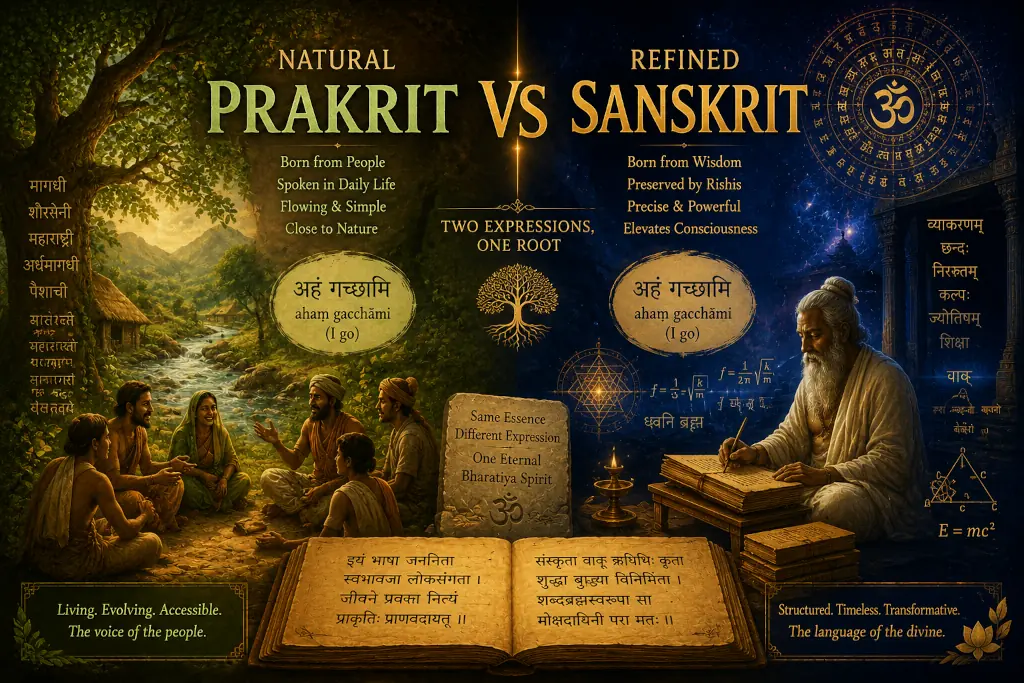
Take for instance in Magadhi Prakrit – r becomes l. Raja becomes laja. If you have ever noticed that Bengali speakers and Odia speakers handle these sounds differently from Punjabi speakers, you are listening to language changes that were already underway before Buddha!
Every language of the world has drifted so far that its speakers cannot read their own literature of a thousand years ago without training. Try making an English speaker read Chaucer’s The Canterbury Tales. They cannot!
But a student who has learnt Panini’s Sanskrit can read Kalidasa and can also read the Upanishads, and any Sanskrit works of today with same ease! That is the very reason Sanskrit was standardized by fixing its rules.
Sanskrit – a language whose rules represent knowledge without wasting words
Sanskrit was the first language to have a real grammar with well defined rules. It was the standard medium of education across gurukulas. And hence, all scholars in ancient India across the subcontinent knew Sanskrit. Its knowledge became synonymous with being educated! Just like how knowledge of English in India today is.
NOTE: Some claim that the ancient Mesopotamian tablets are the world’s oldest grammar. However, they are not complete, systematic grammars; they are fragmented “lexical and grammatical lists” primarily designed for translation and pedagogical training. They do not describe the overarching rules or abstract syntax of the language in the way Panini’s Ashtadhyayi does. Nor, was Panini the first grammarian of Sanskrit. He himself names ten grammarians who came before him – Apishali, Kashyapa, Gargya, Galava, Chakravarmana, Bharadvaja, Shakatayana, Shakalya, Senaka and Sphotayana.
So, while people continued to speak their local Prakrits in their everyday use. In schools and universities of ancient India however, Sanskrit was used as the medium of education as well as communication.
Prakrits – The set of naturally evolved languages in ancient India
The languages that were used in daily life were the naturally evolved ones and were collectively called – Prakrit. Prakriti means nature, and Prakrit was the name for naturally evolved languages. So naturally there were different Prakrit variants in ancient India like Shauraseni, Pali, Magadhi, Maharashtri, Elu, Gandhari, Ardhamagadhi, Paisaci, etc.
Also, note that the Prakrits carry some of the greatest literature Bharat has produced.
- The Pali canon – the entire early Buddhist scripture.
- The Jain Agamas – in Ardhamagadhi, which the Jain tradition calls the very language in which Mahavira taught.
- The Gaha Sattasai of Hala – 700 verses in Maharashtri Prakrit, sharp, earthy, often erotic, and among the finest short poetry.
And now the fact that surprises almost everybody. The earliest inscriptions in India are in Prakrit, not Sanskrit. Ashoka’s edicts, carved across the subcontinent in the 3rd century BCE, are in Prakrit. The first substantial Sanskrit inscription we have – Rudradaman’s rock inscription at Junagadh – comes about 4 centuries later.
Think about what that means. When an emperor wanted to be understood by everybody, he used Prakrit. Sanskrit was for something else. The two languages were not competing. They were doing different jobs. One for the daily ease of use, and the other to preserve knowledge so that it is not lost as languages change.
Think of it something like the file formats today. If the knowledge about how to read a file of a particular format is lost, all those files become useless, even if they exist! Sanskrit was meant to prevent something like that from happening to our knowledge and literature. And the proof that we understand it even today, unlike so many other ancient languages is the proof of its success!
Sanskrit and Prakrit – sharing the same stage
Take any classical Sanskrit drama. Bharata’s Natyashastra lays down which characters speak which language, and the plays follow it. Kings, ministers and learned brahmins speak Sanskrit. Women, children, servants, merchants and jesters use Prakrit.
In Kalidasa’s Abhijnanashakuntalam, the king speaks Sanskrit and Shakuntala answers in Prakrit – and they understand each other perfectly!
Sit with that image for a moment, because it tells you everything. It was a country where an educated person moved between registers the way we move between the English while answering an office email or in an office meeting and the Kannada or Hindi at the dinner table. Nobody thought this strange. It was simply how speech worked, just like it is today.
Why Sanskrit mattered, then?
Putting it all together.
The Prakrits were what India spoke – many of them, changing constantly, regionally distinct, and carrying magnificent literature.
Sanskrit was what India stored knowledge in – one register, fixed by grammar, identical in Kashmir and in Kanchi, and therefore able to carry a text across two thousand years and two thousand miles without degrading.
A scholar in Takshashila and a scholar in Madurai could argue with each other. A commentary written in the 5th century could be read in the 21st. That is not a small thing. That is an entire civilization’s memory, and it held because somebody took the trouble to specify the format.
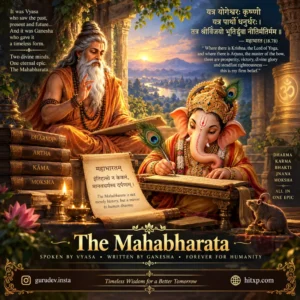
Try opening computer files of 80s or 90s today, and you will understand what I mean. Even in modern computers today we get – this file format is not supported. The well-refined and well-defined Sanskrit did not allow the same to happen with our ancient knowledge. Our ancient texts – starting from the vedas, to upanishads, puranas, ramayana, mahabharata, gita, sutra, samhita – they all not just survive even today – we also read and understand them – using the same rules of Vedic Sanskrit and Classic Sanskrit.
The one-line version
Prakrit was grown. Sanskrit was groomed.
Same soil. Same roots. One left to the weather, one shaped and then held.
Start with Sanskrit Lesson 1 – The Secret Science behind Sacred Sanskrit, where we attempt to learn Sanskrit by learning more about it first. There needs to be a reason first, which then ignites a passion, to learn something. Learning with passion makes learning more easy and enjoyable, after all!