There is a story in Taittiriya Samhita about a grammar mistake killing an asura! Yes, a grammar mistake!!
The Rise and Fall of Vritra
Tvashta, the artisan god recognized for his craftsmanship, including the creation of Indra’s Vajrayudha (thunderbolt), wanted revenge on Indra for some reason. So, he performed a yajnya (a ritual) to have a son who would kill Indra. Thus was born Vritra – his son. Tvashta blessed him uttering the words for which he had conducted the elaborate ritual – “Indrashatru, grow!”
Except that Tvashta got the pitch wrong on one syllable while pronouncing it. Yes, the syllable itself was correct, only the pitch was wrong.
He meant indraśatrúḥ ie “the killer of Indra”. What came out of his mouth instead was índraśatruḥ which meant “he whose killer is Indra”! Same letters, same word, same order. One syllable raised in the wrong place. Observe the difference between i and u in both. That marks the pitch.

Vritra grew up only to be killed by Indra later. Because, in the Vedic Sanskrit, it was not just what you say that mattered, but how you say it as well. The reason why vedas were not written down unlike other texts, but were recited and passed on through generations, was because one should not get the recitation wrong. Incorrect pitch changes the meaning of what you say. Like in the case of Vritrasura, ends up the exact opposite of what you wanted it to mean!
Wait, but no pitch-accent system in Sanskrit today
If you know the Sanskrit they teach in school today, then this story makes no sense at all! That is because, in modern Sanskrit (called Classical Sanskrit) there is NO difference between those two words. Not at all! You cannot even write the difference down properly of those two vedic words. The story is not just untranslatable – it is unpronounceable as well in today’s Sanskrit!
Why? Because the Sanskrit of the Vedas and the Sanskrit of Kalidasa are not the same language. Read on now.
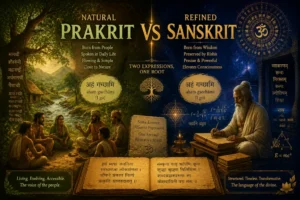
Two languages, one name
When we say “Sanskrit” we usually think it is one single language. But the Sanskrit of the Rig Veda and the Sanskrit of Shakuntala are separated by a gap wider than the one between Old English and yours.
And this is not some modern academic discovery. Panini knew it. In his Ashtadhyayi, written around 2500 years ago, he uses two different words for the two languages, and tags his rules accordingly:
- Chandas – the metrical language of the Vedas
- Bhasha – the spoken, living language of his own day
When a rule applies only to the older Vedic Sanskrit, Panini calls it chandasi, ie “in the Chandas”. Bhasha is the classical sanskrit that he standardized by simplifying Vedic Sanskrit and binding it in his nearly 4000 rules of Ashtadhyayi.
Difference 1 – The Vedas are not spoken. They are sung.
Vedic Sanskrit is a pitch accent language. Every syllable carries one of the three musical tones:
- Udatta – the raised tone
- Anudatta – the not-raised tone
- Svarita – the falling or gliding tone connecting the raise and the not-raised
This is not some decoration. Neither is it some “chanting style”. The pitch is part of the word. It is part of the language itself! Change the pitch and you have changed the word and hence the meaning of what you said!
This is what happened to Tvashta. In Vedic Sanskrit, for tatpurusha samasa the accent falls on the second member (killer of Indra), but in a bahuvrihii samasa it falls on the first (killed by Indra). That is the difference. The entire outcome of a war depended on which syllable went up while chanting!
This is also why every Vedic manuscript is always marked with accent notation – those little strokes you see above and below the letters. But the texts of Classical Sanskrit have no such marks.
Difference 2 – Classical Sanskrit lost the accent completely
By the time of Kalidasa, the three tones were gone. Classical Sanskrit is stress-neutral, and the tonal distinction that once separated two meanings simply stopped existing.
So how does Classical Sanskrit survive without it? Where Vedic could distinguish two compounds by pitch alone, Classical Sanskrit has to break the compound up and spell it out. Classical Sanskrit traded precision for convenience.
Difference 3 – Vedic verbs could do things Classical verbs cannot
The Vedic verb system is enormous. very huge. It has moods that Classical Sanskrit hasn’t.
The subjunctive (let) – for what might, should or will happen. Almost entirely gone from Classical Sanskrit. It survives only as a fossil inside a few imperative forms.
The injunctive – a strange, tenseless form used for timeless statements and prohibitions. Again gone in Classical Sanskrit.
Vedic Sanskrit maintained a real working distinction between the imperfect, the aorist and the perfect verb tenses – the three different flavors about the “past”, each saying something different about how the past event relates to now. Classical Sanskrit kept all three forms, but stopped caring about the difference. Poets were free to pick whichever one fit the metre.
Think of it this way. Vedic Sanskrit is like a camera with full manual controls. Classical Sanskrit is the same camera with most controls being automatic. You can still take beautiful photographs. You just can’t do everything the older machine could :)
Difference 4 – Even the word endings changed
Take the simplest possible example. “By the gods”, which is the instrumental plural of the word deva
- Vedic: devebhiḥ
- Classical: devaiḥ
Both are correct. Both are Sanskrit. They are just millenia apart. Vedic frequently allows alternative endings that Panini’s Bhasha already streamlined out. Vedic sandhi is looser, its word order is more free, its metre governs what the grammar permits.
Difference 5 – The same word, the opposite meaning
Asura. If you look at the oldest layers of the Rig Veda, one observes that an asura is a mighty, lordly being. The word describes Varuna, Mitra, and even Indra! It is a compliment. Yes, it does not mean demon. Remember, Vritra was the son of the artison god!
By Classical Sanskrit, we start seeing that asura means demon.
Now look across the border at the ancient Avestan language of Persia (ancient Iran), it is Sanskrit’s closest cousin. Their supreme god is Ahura Mazda. And their word for demon? Daeva – the exact opposite meaning of Sanskrit deva, god. Looks like the two sides ended up warring against each other, got separated, and words for each other gained opposite meanings on either side.
The two languages inherited the same pair of words and swapped their moral polarity. Somewhere in that inversion sits a piece of history nobody has fully recovered.
The proof from inside the tradition – they needed a dictionary for their own scripture
Here is the strongest proof that the two Sanskrits diverged, and it comes not from any western indologist but from India’s own scholars.
Before Panini, there was Yaska, who wrote the Nirukta – a work of etymology whose entire purpose was explaining Vedic words that his contemporaries could no longer understand! It is an amazing work in itself!
Now try to understand what this means. Sanskrit scholars, in a Sanskrit-speaking society, needed a reference work to decode their own scripture. Yaska even records earlier authorities who had already given up on certain words!
And this is exactly why Shiksha (phonetics) and Nirukta (etymology) exist as two of the six Vedangas. You do not build an entire discipline around how to pronounce a text unless you have realized that people are about to stop pronouncing it correctly.
The tradition saw the drift was coming, and hence built instruments against it in an effort to prevent it from happening. It happened nevertheless.
Why did one Sanskrit freeze while the other kept moving?
The reason being, two completely different methods were used to preserve them.
Classical Sanskrit was used. It was written down, read, adapted, played with by poets and dramatists and philosophers. Anything you use, you change.
Vedic Sanskrit was recorded. And the recording technology was the human voice. The oldest text humanity is aware of survives even today after thousands of years, while the texts written mere centuries earlier have been completely lost! Ancient Indians made entire generations of humans as the backup resources via chanting the same texts in same pitch and accent. That has survived till to date!
The Vedas were memorized through the pathas (which are deliberately engineered redundancy schemes). In samhita patha you recite continuously. But, in pada patha you break every word apart. And, in krama patha you chant each word paired with the next – 1-2, 2-3, 3-4. And then it escalates. Jata patha takes each pair forwards, backwards and forwards again. Ghana patha scrambles them in still longer permutations.
Recite a text in all these patterns and every syllable, its accent, and its exact position gets locked in by cross-checking against every neighboring syllable. Corrupt one word, and the permutations will stop agreeing with each other. It is an error-correcting code, invented thousands of years before anyone had a word for one. Yes, the same error correction code like CRC we have today to verify the integrity of digital data. Vedic seers engineered them to preserve vedas thousands of years ago!
And note what this system preserves. Not the meaning. The sound. That is exactly the reason why the pitch accents of Vedic Sanskrit are still with us, still chanted correctly today across the temples and homes of Bharat, thousands of years after they were composed.
To summarize
- Sanskrit is not one language. Panini himself called them Chandas and Bhasha.
- Vedic Sanskrit uses pitch accent, where a raised syllable changes the meaning of a word. Classical Sanskrit lost this entirely.
- Vedic has moods and tense distinctions – subjunctive, injunctive, a live three-way past – that Classical Sanskrit dropped or flattened.
- Word forms shifted: devebhiḥ became devaiḥ. Meanings shifted: asura went from “lord” to “demon”.
- Yaska’s Nirukta proves the gap was already felt from inside the tradition – he wrote a dictionary to preserve meanings.
- Vedic survived unchanged not because nobody touched it, but because it was preserved as sound rather than as text, by the pathas for generations.
Every civilization on this planet has lost its oldest language. Egyptian, Sumerian, Akkadian, Hittite – all had to be dug up and guessed at from stone, centuries later, by strangers.
Only one civilization thought to keep a backup. And it chose the one storage format that has never once needed an artificial device to play it back :)
If you want to learn Sanskrit by appreciating the Science behind it – read Secret Science behind the Sacred Sanskrit